 ZARI Blog
Coastal soil salinity in Africa: diagnose, drain and restore production
An evidence-based field guide to soil and water testing, drainage, crop choices and the economics of salt-affected coastal farms.
· ZARI AGRI
Understand the source of salts
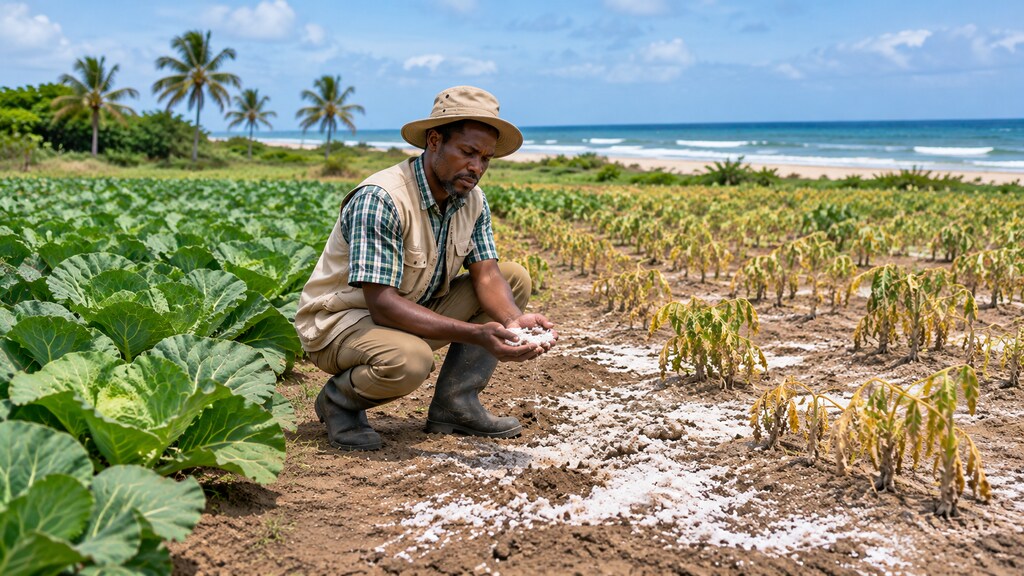
Salt may enter through brackish irrigation, seawater intrusion, shallow groundwater or evaporation from poorly drained soil. Coastal conditions differ widely across Senegal, Guinea-Bissau, Ghana, Togo, Benin and Mozambique. A white crust is a warning to investigate, not a laboratory diagnosis.
Test the field and irrigation water
Map weak crop patches and collect representative samples from several locations and depths. Ask a qualified laboratory for soil electrical conductivity and pH, and sodicity indicators when appropriate. Test irrigation water as well: nutrient stress, drought and root disease can resemble salt injury.
Drainage comes before leaching
Check whether excess water can actually leave the site. Leaching with suitable water may lower salts in the root zone where soil permeability and drainage permit it. Adding water without an exit can raise the water table and worsen waterlogging. Gypsum is not a universal remedy; it should follow a confirmed sodicity diagnosis.
Choose an adapted cropping strategy
Compare locally available crop varieties against measured salinity and water quality. Mulch can reduce surface evaporation; raised beds and properly managed drip systems may help control salt distribution. Track salinity over time because weather, groundwater and irrigation quality change during the season.
Build a realistic business case
Include testing, drainage rehabilitation, water supply, labour, crop trials and temporary yield reductions in the budget. Trial the approach on a small area, record saleable output and calculate cost per unit before scaling. Very severely affected land may be better suited to another productive use.
When to involve an expert
Recurring salts, rising shallow groundwater or collapsing infiltration require local soil and irrigation expertise. Avoid universal chemical amendment rates without analysis.
Field action plan
- Test the field and irrigation water
- Drainage comes before leaching
- Choose an adapted cropping strategy
- Build a realistic business case
Frequently asked questions
Will scraping away white salt fix the field?
No. Salts can remain in or return to the root zone unless the cause is corrected.
Scientific references
coastal soil salinity · salt affected soils Africa · irrigation water testing · soil EC · drainage design · saline agriculture