 ZARI Blog
Tassaout and El Kelaa des Sraghna: land, water and the pride of Moroccan olive oil
· ZARI AGRI
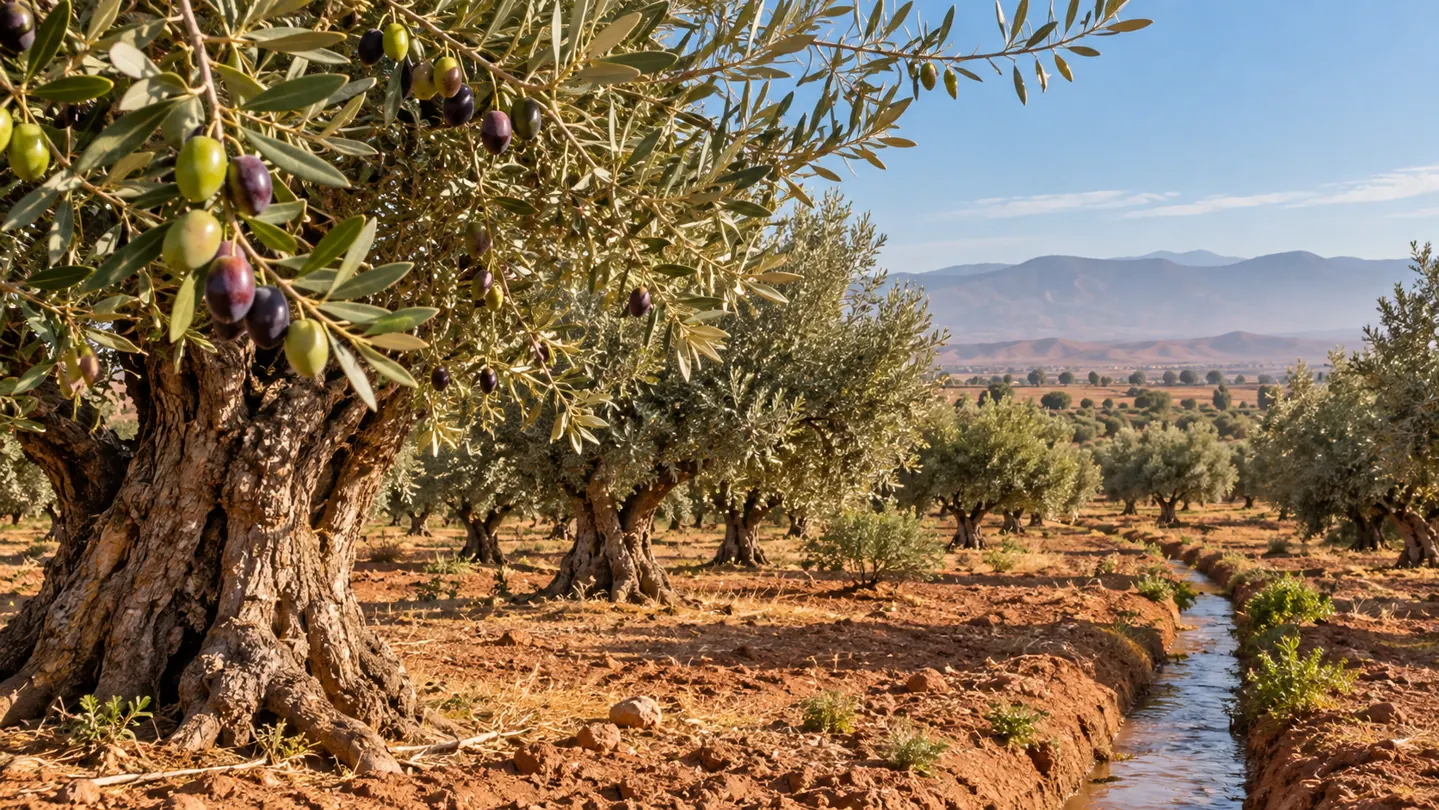
In Tassaout, an olive tree means more than an end-of-year harvest. It shapes the village landscape, carries family memories and reflects a long relationship between land and water. Around El Kelaa des Sraghna, El Attaouia and Bni Amer, agriculture is inseparable from planting, irrigation channels, olive mills and markets. Each olive brings together the grower's care, the picker's work, the miller's skill and the household waiting to taste the new oil.
This is the story of a place that deserves to be known by its own names and history, and of an oil that inspires local pride. It is also a question about the future: how can the area protect its water and product quality while giving the people who produce this wealth a stronger place in the value chain?
In this article
- Tassaout and the Sraghna plain: olives shaped by water
- A history of land, channels and inherited knowledge
- Communes and douars: precise names and distinct places
- From river and seguia to dams and irrigation networks
- How the river contributes to groundwater recharge
- Planting for the next generation
- What has changed in recent years?
- When does harvest start, and when does milling begin?
- From tree to mill: keeping the fruit's value
- Why Tassaout oil inspires local pride
- Bni Amer's Wednesday souk: a history of trade and olive-growing memory
- Tassaout bridge at Errafiaya: a crossroads of trade, grilling and hospitality
- Protecting the water, the name and the producer's place
Tassaout and the Sraghna plain: olives shaped by water
El Kelaa des Sraghna province belongs administratively to Morocco's Marrakech-Safi region. Its plains and irrigated districts form an important part of the agricultural landscape around Marrakech. When Tassaout oil is discussed among the oils of the Haouz, this article uses Haouz in its wider geographical and agricultural sense. It does not place every commune mentioned inside the administrative province of Al Haouz. Tassaout itself names a river, an agricultural area and irrigation districts whose boundaries do not coincide exactly.
The Tassaout rises in the High Atlas and belongs to the Oum Er-Rbia river system. It connects the mountains to the plain, carrying part of the water generated by upstream precipitation towards farmland. A green orchard therefore represents a water source, an allocation system, soil and years of work. Being close to the river does not mean that every field receives the same amount of water or has the same irrigation conditions. [1]
A history of land, channels and inherited knowledge
The history of El Kelaa des Sraghna cannot be reduced to one founding date. The municipality's historical account discusses different interpretations, cites a written reference to the stronghold in 1588 and considers fortifications from the reign of Moulay Ismail. Settlement, the fortress and the town's later growth are separate historical questions. The sources reviewed do not establish the year when the first olive tree was planted in Tassaout. An invented ancient date would add nothing to an already valuable heritage. [2]
The depth of that heritage is better understood through knowledge passed between generations: choosing planting material, tending trees, sharing water and organising harvest work. A traditional irrigation channel, or seguia, also represents a social arrangement. Who receives water, when does it arrive, who maintains the channel, and which crops can it support? Planting an olive tree commits a household beyond a single season.
A tree cared for over time recalls both dry years and generous harvests. That memory helps explain the attachment to local oil. It carries a place and a family experience as well as colour and flavour. Telling this story accurately gives the people behind the product a visible place.
Communes and douars: precise names and distinct places
The province has 43 communes: 39 rural and four urban. Commune names and administrative circles have been checked against High Commission for Planning tables for the 2024 census; Latin spellings follow HCP publications. A commune is an administrative unit, a douar a settlement within the countryside, and a market or trading centre does not necessarily constitute a separate commune. [3] [23]
| Administrative or local setting | Names | Clarification |
|---|---|---|
| Communes in Laattaouia circle | Bouya Omar, Choara, Dzouz, Fraita | A selection of communes, not an exhaustive list of the olive-growing area. |
| Communes in El Kelaa–Beni Ameur circle | Errafiaya, Taouzint, Sidi El Hattab, Chtaiba | The circle and caidat are different administrative levels. |
| Bni Amer Wednesday market | El Aamria commune | The market is distinct from the Tassaout bridge trading centre in Errafiaya. |
| Douars in Errafiaya | الرويبعات، أولاد رافع | Names retained in the Arabic spelling documented in parliamentary written question 10528. |
| Towns and service centres | El Kelaa des Sraghna, Laattaouia | Urban communes; Laattaouia is also commonly called El Attaouia. |
A MAP news-agency report dates the inauguration of Tassaout caidat to 15 April 2010, covering Errafiaya, Taouzint, Sidi El Hattab and Chtaiba. These four communes should therefore not be labelled Bni Amer caidat on the basis of a later newspaper account. The wider circle appears in the 2024 tables as El Kelaa–Beni Ameur. Arabic spellings differ in some official documents; the HCP annex is the reference used here. [21] [3] [22]
Accurate place names also recognise producers' work. Recording the commune and douar with their permission, alongside harvest and milling dates, gives an oil a clearer identity than the broad label “local oil”.
From river and seguia to dams and irrigation networks
Modern irrigation developed in stages. The basin agency's assessment dates construction of Moulay Youssef dam to 1969 and impoundment of the Timinoutine regulating dam to 1981. Development of Tassaout Amont, the upper irrigation district, progressed during the 1970s. Tassaout Aval, the lower district, was equipped in phases from the late 1980s through the 1990s. These are dates in the history of water infrastructure, not the beginning of local olive cultivation. [1] [6]
The lower district does not depend solely on water from the local river. It also connects to supplies from the Bin El Ouidane system through the T2 canal. Water arriving at a farm is therefore part of a wider network shaped by reservoir storage, rainfall, allocation decisions and competing users. The Tadla regional agricultural development office documents Bin El Ouidane's role in supplying Tassaout. [7]
When available, irrigation helps growers manage tree growth and fruit development. It also requires knowledge of soil needs, network maintenance and respect for irrigation turns. Infrastructure can provide relative stability, but it cannot remove the effects of a dry year.
How the river contributes to groundwater recharge
Some water can infiltrate through permeable river deposits and soil layers. Rainfall and irrigation return flows can also contribute to underground supplies, with the amount varying by location, soil and practice. Research on the Haouz shows that groundwater-level changes differ across the plain and that irrigation return flows belong in the water balance. [8]
It is therefore reasonable to say that the Tassaout and its irrigation system can support aquifer recharge where conditions allow. This does not mean groundwater levels rise continuously. If pumping exceeds replenishment, levels can fall even in an irrigated area. Drip irrigation may reduce water applied to a field, but it may also reduce deep return flows. Basin-wide savings depend on total consumption, planted area and groundwater withdrawals.
Protecting the olive landscape begins with measuring and managing its water. Monitoring wells, rainfall, irrigation and avoidable losses tells us more than a single photograph of a flowing river. This article does not provide a field measurement of the aquifer's level in October 2026.
Planting for the next generation
Moroccan Picholine has a central place in the country's olive heritage, alongside other varieties and selections including Haouzia and Menara. This does not mean every orchard in Tassaout contains the same cultivar. There is also an important distinction between the olive variety named Tassaout and olive oil grown in the geographical area: the place name alone does not identify the variety. [9]
The INRA experimental farm at Tassaout hosts an international olive collection. The collection was inaugurated in 2002, while institute documents describe planting at the farm from 2003. This gives the area a role in conserving diversity and studying varieties, beyond commercial production alone. [10] [11]
For new orchards, first fruit and dependable commercial production are different milestones. Bearing depends on variety, planting material, soil, irrigation and management. Some early-bearing material may fruit from the third year under suitable conditions, but that is no universal promise of a commercial crop. A simple field record linking planting, pruning, irrigation and yield provides a stronger basis for decisions than memory alone. [12]
What has changed in recent years?
Changes are visible in mills, field demonstrations, irrigation management, quality control and product marketing. For the 2020–2021 season, Al Moutmir reported 138 olive demonstration plots in ten communes of the province. This describes a particular programme, not all orchards or a uniform increase across provincial production. [13]
In El Attaouia, the seventh National Olive Fair, held from 21 to 24 January 2026, included agricultural research and varieties. INRA's 2025–2028 research programme also addresses water, adaptation and quality. These developments show an active sector, but they coexist with drought pressure and fluctuating harvests. Better equipment does not mean output increases uninterruptedly every year. [14] [15]
For a small grower, progress also means understanding the cost per litre, keeping lots separate, choosing appropriate packaging and reaching a buyer who values quality. Simple digital records can preserve harvest and milling dates, available test results and lot photographs. That makes Tassaout's identity easier to explain and verify outside the local market.
When does harvest start, and when does milling begin?
The start depends on cultivar, ripeness, weather and whether the olives are intended for the table or for oil. A field report from the province documented an October start in the 2020 season. Moroccan agronomic references place much oil-olive harvesting in late autumn and early winter. The calendar below is a planning guide, not an official opening announcement for 2026. [16] [17]
| Indicative period | Seasonal activity | Practical decision |
|---|---|---|
| September–October | Monitor colour change and ripening; prepare harvesting and milling. Some early lots may start in October. | Inspect fruit and its intended use rather than applying one orchard's date to all farms. |
| November–December | A usual main period for harvesting and milling many oil olives. | Coordinate picking, transport and mill capacity to shorten waiting time. |
| January, depending on the year | Possible late lots or continued trading of the crop. | Distinguish the date olives reach a market from when they were picked. |
| From the first suitable ripe lots | Milling begins when appropriate fruit arrives and the mill is ready. | Process as soon as possible after picking; do not store fruit while waiting for a particular month. |
Position as of 9 October 2026: we have not verified an official local announcement setting one date for all Tassaout harvesting or mill openings this season. Growers should confirm a reception slot and assess their own fruit. A dam's construction date or a collection's inauguration is not the historical start of the area's olive production.
From tree to mill: keeping the fruit's value
Picking begins a stage as important as caring for the orchard. Fruit needs clean handling, separation of damaged olives and prompt transport. At the mill, leaves and impurities are removed before washing, crushing, malaxation and oil separation. Pressing and centrifugation are different systems; a modern machine cannot compensate for poor hygiene or process control. [18]
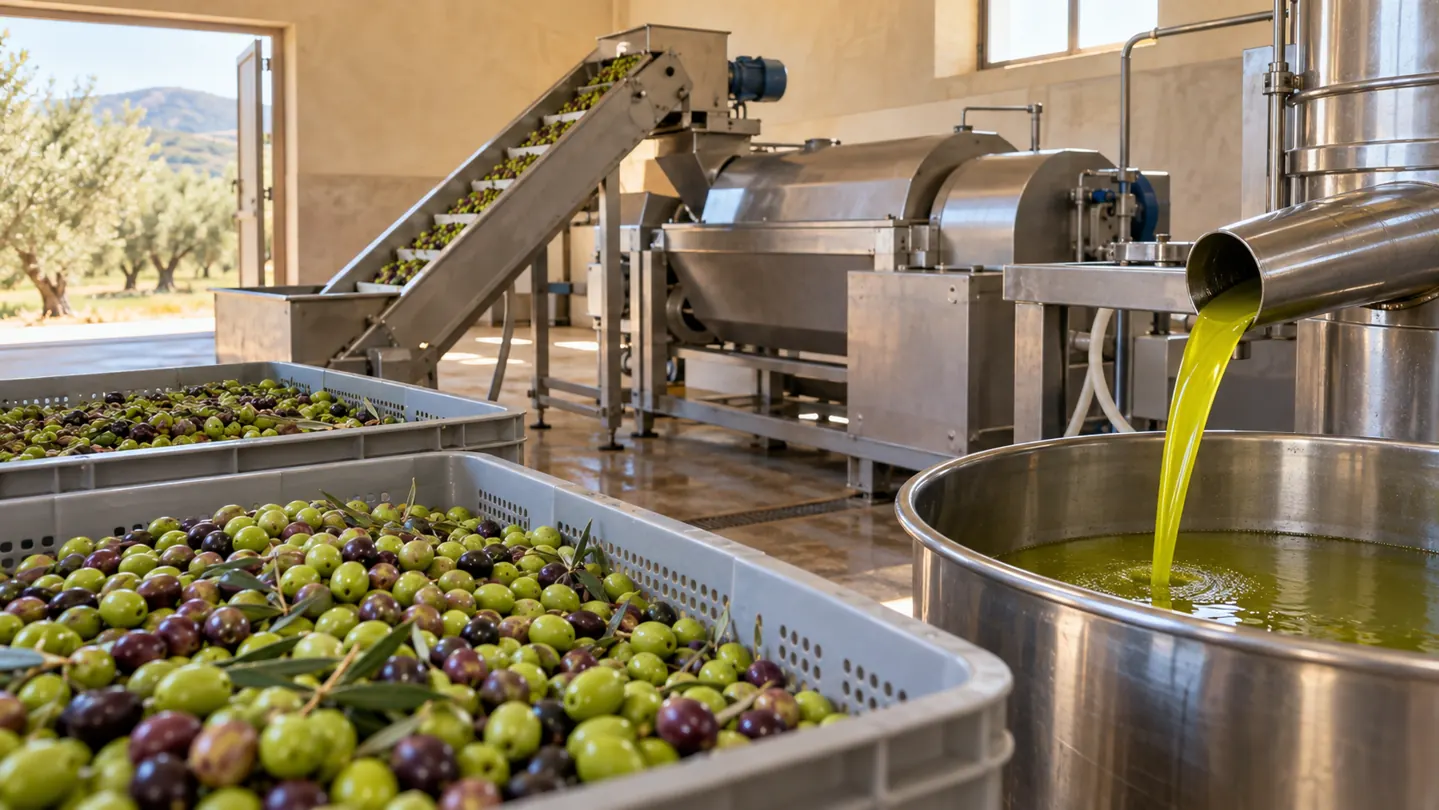
Arranging mill reception before picking and recording harvest, arrival and milling times helps producers compare lots and understand differences. After extraction, suitable food-grade containers and protection from light, heat and air remain essential. Leaving good oil near a heat source can undo part of the care invested earlier. [19]
Why Tassaout oil inspires local pride
Tassaout oil is among the locally valued oils of the wider Haouz and Sraghna agricultural area; its admirers regard it as one of their finest. That reputation combines attachment to the land, practical knowledge and trust built through repeated dealings. Field reporting documents the standing of the province's oil and El Attaouia's mills. It is a reputation worth explaining without turning it into an unsupported universal ranking. [16]
Each lot still needs to be assessed on its own merits. Variety, ripeness, fruit condition, processing delay and storage all influence the result. Colour or the word “traditional” cannot establish extra virgin status, which depends on chemical and sensory characteristics. The name Tassaout alone also proves neither organic certification nor a protected designation of origin. Accurate information strengthens the place's reputation. [20]
Bni Amer's Wednesday souk: a history of trade and olive-growing memory
Bni Amer's Wednesday market is associated with El Aamria commune in El Kelaa des Sraghna province. Its name preserves the rhythm of a weekly gathering within a wider circuit of traders. This is Bni Amer in Sraghna, distinct from Béni Amir in Tadla. [5]
Its roots belong to the tradition of rural and tribal markets, bringing together crop sales, household supplies and relationships between villages. A Maal Fallah report dated 8 January 2019 describes the sequence of Monday trading in El Kelaa des Sraghna, Tuesday in Tamallalt, Wednesday in Bni Amer and Thursday in Laattaouia. Staggered market days allow trade to circulate; together they form a weekly connection between fields and consumers. [24]
A field study published in 2021 documents the market's relationship with transport. A Hawamich report from the same year places it within Sraghna's trading traditions while describing the vulnerability of regional markets to pandemic closures. These accounts establish its role, but the sources reviewed do not establish a founding date or the date it moved to its present site. [5] [25]
During the olive season, that history takes tangible form: growers bring their harvest, buyers compare lots and negotiations begin. Knowledge of the orchard meets the buyer's experience and the mill's requirements. Repeated encounters give reputation a practical value. Each lot still has its own origin and picking date; a market brings produce together without certifying its provenance. Bni Amer therefore preserves the memory and relationships of a trade as well as providing a place to buy and sell.
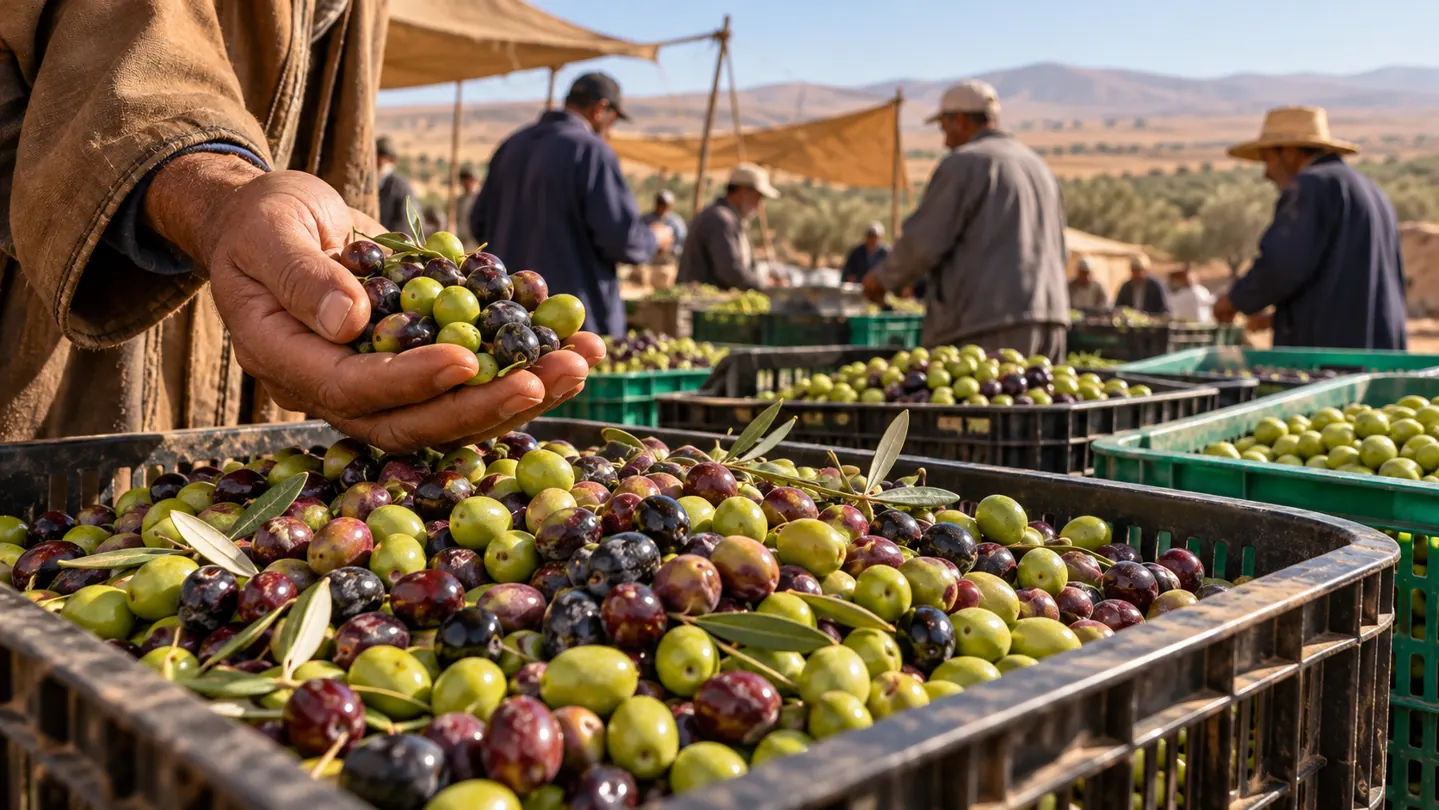
A video published on 30 October 2025 provides a dated view of Bni Amer's olive market. It is not footage of the October 2026 season, and its historical prices should not be used to price a new crop. Watch the original market video on YouTube, from the Al Houli Sardi – Talyani Sraghini channel.
Women also deserve a visible place in this account. A 2018 local report documented women in Bni Amer working to add value to olives and oil. Recognising that contribution means identifying the people doing the work and helping preserve the value of their labour. Every litre passes through a chain of skills and services; the area's wealth cannot be measured only by counting trees. [4]
Tassaout bridge at Errafiaya: a crossroads of trade, grilling and hospitality
At Errafiaya, the Tassaout bridge is more than a crossing over water. It lies on national road 8, along the Béni Mellal–El Kelaa des Sraghna–Marrakech corridor, where the route north towards Bni Amer and onward to Khouribga connects. The map brings river, roads and settlement into the same frame, helping explain the location's importance to traders, travellers and nearby villages. [22] [26]
A parliamentary question also documents a provincial road linking the bridge with Errafiaya, Oulad Bouali Loued and Oulad Aamer, passing through the two Errafiaya douars named above. The crossing connects rural communities with services as well as carrying intercity traffic. This is specifically the bridge at Errafiaya; other crossings exist elsewhere on the Tassaout. [22]
In the local account shared with ZARI for this article, the bridge area is a trading centre and a stopping place for merchants and travellers. Cafés offer a break from the road, simple local restaurants make that pause a meal, and stalls display regional products and seasonal fruit. Travel meets the agricultural calendar here: a purchase or a lunch stop allows some of the value of passing traffic to stay with local people.
Traditional grilling gives this portrait its distinctive flavour. The account associates the bridge with grilled lamb and mutton from local flocks: a fire, a portion chosen to suit the appetite, and a short pause that restores the human scale of a journey. For someone who enjoys grilled meat, the name Tassaout bridge is an invitation to stop. A freshly grilled portion can become a memory of the road and a reason to return.
From orchard to mill, and from Bni Amer's souk to the bridge, one landscape emerges through olives, water, trade and hospitality. The reference to local livestock expresses that identity; it does not imply organic certification or a verified uniform farming system across all sellers. Explore Errafiaya and the bridge area on the map.
Protecting the water, the name and the producer's place
Tassaout deserves a faithful digital presence: villages, growers, mills, history and a season that returns each year. An honest lot record can include production location, crop year, milling date, producer identity with permission, packaging and available analyses. Authentic, dated photographs add further value when their location and ownership are clear.
Protecting this wealth also means managing mill residues and avoiding uncontrolled releases into soils and waterways. Better water management, consistent quality records and clear presentation make the product more credible to nearby and distant buyers. The future of Tassaout oil rests on that balance: living trees, protected water, recognised producers and oil that retains its value all the way to the table.
Sources and references
Sources reviewed for publication on 9 October 2026. Historical dates refer to the events cited; the seasonal calendar is indicative. Links retain the original source language.
- ABHT: Tassaout sub-basin assessment, 2016
- El Kelaa des Sraghna municipality: local history
- HCP: El Kelaa des Sraghna provincial data
- Al Ayam 24: women and olive processing in Bni Amer, 2018
- Field study of transport and markets in El Kelaa des Sraghna
- HNSJ: climate and olive cultivation in Sraghna, 2023
- Tadla regional agricultural development office: water resources and infrastructure
- IRD: agricultural modernisation and Haouz groundwater levels, 2004
- Interprolive: olive orchards and varieties
- Le Matin: international olive collection inaugurated, 21 March 2002
- INRA Marrakech: Tassaout experimental farm
- INRA Meknes: olive diversity and genetic resources, 2018
- Al Moutmir: demonstration plots, 18 November 2021
- INRA: National Olive Fair in El Attaouia, January 2026
- INRA: olive research programme 2025–2028
- Le360: field report on harvest and mills, 10 November 2020
- Agricultural Technology Transfer in Morocco: the olive growing cycle
- International Olive Council: quality management for olive mills
- International Olive Council: consumer guidance on oil storage
- International Olive Council: standards, testing and sensory assessment
- MAP: Tassaout caidat inaugurated, 15 April 2010
- House of Representatives: written question 10528, Tassaout bridge and nearby douars
- HCP: French administrative names in provincial study using 2014–2024 data
- Maal Fallah: weekly markets in Sraghna, 8 January 2019
- Hawamich: Sraghna markets, tradition and the pandemic, 10 June 2021
- OpenStreetMap: Errafiaya, river and road network; checked 9 October 2026
Introduce your product and the place it comes from
Growers, cooperatives and millers can present accurate origin, crop year, milling date, packaging and available analyses on ZARI Market, with genuine photographs they have permission to publish.
Visit ZARI Market